
Whether you’re a small-scale retailer with a local target audience or an international distributor, online product descriptions for your goods matter quite a bit. According to Shopify, 16.1% of all retail sales are expected to shift to online platforms by the end of 2020. Subsequently, by 2021, 53.9% of all online sales will happen via mobile devices, given their accessibility.
This makes writing proper product descriptions for your online storefront a must, especially given the fierce competition in the wake of COVID-19 and social distancing. That being said, what makes a good Shopify product description attract the right audience? What are the benefits of carefully writing and curating your product descriptions going into 2021?
Why Writing Proper Product Descriptions Matters
Let’s take it from the top and consider the “why” behind writing product descriptions in tandem with using Shopify for your online store. According to the Hosting Tribunal, 20% of eCommerce platforms use Shopify, with the platform achieving a 90% satisfaction rate from customers who engage with stores using Shopify.
Your product descriptions are effectively the first and last line of defense when it comes to a convincing cold lead to convert into a customer. As such, you should pay close attention to how you write, edit, and format each product’s description.
Bridgette Hernandez, Head of Content Writing and Development at Supreme Dissertations, said that: “It doesn’t matter how good your back-end CMS is if your product descriptions are poorly written. Create a uniform system of writing and formatting descriptions of each of your products to create a cohesive user experience. Doing so properly will elevate your platform’s reputation and SEO ranking while also giving it a competitive edge.”
If we were to break down the practical reasons how proper product description writing can help your business, the list would include the following:
- Create and maintain a professional brand image for existing and new customers
- Humanize your brand and build a stronger emotional connection with customers
- Increase your website’s global SEO ranking due to structured writing and formatting
- Attract more retailers and distributors who may want to collaborate with your brand
Writing Tips for Product Descriptions that Sell
1. The Basics of – What is the Ideal Product Description Length?
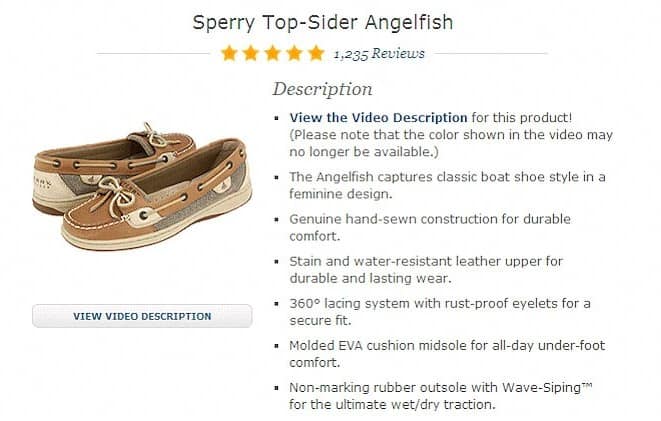
Let’s discuss the technical aspects of a product description before we delve into more practical tips. What’s the ideal length of a Shopify product description? To keep things simple and to-the-point, your product descriptions should be within 150-200 words, depending on what you’re selling. Writing such as product title, specifications, benefits as well as any social proof or testimonial should fit into that length.
Content that goes over 300 words is already considered to be a small article and doesn’t constitute a product description anymore. We will discuss SEO and keyword stuffing in the following paragraphs, so this is also something to keep in mind for the description’s length. Remember that eCommerce shops are driven by multimedia just as they are by product descriptions – make your writing complement the visuals for each product.
When it comes to formatting, that’s up to you. A legible formatting practice is to separate your information into bullet points and keep each point to a single sentence in length. Alternatively, 2-3 paragraphs with 2-3 sentences each will do the job just as well.
2. Assemble your Content Stack
The writing tools you use to write product descriptions for your Shopify platform will dictate their formatting going forward. As such, you should start the process of writing your descriptions by settling for several reliable platforms you will use for the foreseeable future.
Marie Fincher, Content Writer and Chief of Content Editing at Trust My Paper, said that: “Your writing will only be as good as the software and services you use to back it up. This is especially true if you are not a native speaker and aim to translate or localize your eCommerce platform later on. Explore the writing tools available online and create a group of reliable platforms you will reference ad infinitum.”
You can write your descriptions through tools such as MS Office and Google Docs to get a feel for your tone of voice and style. Subsequently, more specialized platforms such as Evernote and Grammarly can help you edit and format the descriptions to better fit your website’s design.
3. Adopt a Keyword-Driven Writing Approach
Writing product descriptions for your eCommerce platform is somewhat different from traditional content marketing due to its sales-centric nature. This is why you should adopt an SEO strategy from the get-go and ensure that your online storefront is as visible to customers as possible. Platforms such as Google Keyword Planner and SEM Rush can help you find the right keywords for your product categories quite efficiently.
Make it a habit to check these and other platforms periodically for changes in keyword trends and update your writing accordingly. While it may seem contrary to creative writing, a keyword-driven approach will allow you to reach a much wider audience than you otherwise would. This is especially true if you translate content into multiple languages since you will need to use keywords specific to those languages to rank locally.
4. Benefits over Features
If you focus on B2C audiences, you should focus on the benefits over the features of your products. Average customers rarely want to find out the technical specifications of a product before they figure out how the product can help them personally.
Writing the benefits down before going into technical features will ensure higher engagement on your platform. Not every lead you acquire will be versed in IT, mechanics, electronics, and other fields that find their way into eCommerce features lists. Open your product descriptions with benefits, and your efforts will pay off consistently.
In addition, you should pay close attention to your product description formatting, as many customers will likely visit your storefront via mobile. This will help you create more appealing, user-friendly product descriptions that users can quickly scan to find out what they want to know.

5. Combine Writing with Multimedia
While not strictly related to writing, multimedia can elevate your product descriptions and ensure better reach. Original images, videos, and demonstrations of your products’ functionality can do wonders for engagement.
These elements can also boost your SEO ranking significantly, especially if you offer subtitles and transcripts in other languages as a bonus. Tools such as Canva and Easil are great for DIY multimedia design, which can help improve your product descriptions’ presentation. Coupled with previously written descriptions, multimedia elements will make your online storefront shine and become more appealing to a wider range of customers.

6. Engage via Calls to Action
Lastly, your product descriptions should always entice the reader to perform a certain action. The so-called “calls to action” can help improve your engagement and gain more customers as a result of their inclusion. Product descriptions without calls to action will fall on deaf ears and fail to generate the interest your store deserves.
Calls to action can range from simple “Let us know what you think” to “Buy now and receive a discount” messages. You can combine calls to action with branded messages and phrases unique to your business to make the writing more memorable. Write different calls to action for different product categories and parts of your website to make the content more dynamic in the customers’ eyes.

Cater to your Target Audience (Conclusion)
Writing product descriptions for your Shopify-based online storefront is all about appealing to your target audience. For example, if you sell children’s toys and apparel, you should target parents and grandparents. The same rule applies to any other product category, as generalized writing will rarely help you sell more products.
Develop your writing style and tone of voice through product description writing. Make sure that all of your product descriptions are written and formatted in the same manner to create a uniformed customer experience.