Tag: SEO workflow

  • Three-Step SEO Workflow for Better Rankings

    Three-Step SEO Workflow for Better Rankings

    Watch the walkthrough first: The Loom above shows the three-step SEO workflow in action before the written breakdown. If you are short on time, use the checkpoints below to jump to the part that matches your current SEO bottleneck.
    Video checkpoints:

    • 00:00 – Three-step SEO plan: Start with the technical baseline so keyword and backlink work is not built on preventable blockers.
    • 03:08 – Select best target keywords: Compare demand, intent, authority gaps, and business fit before choosing a target.
    • 07:36 – Optimize pages for keywords: Tighten the title, H1, copy, headings, meta description, image alt text, and internal links around the chosen topic.
    • 09:15 – Reverse engineer backlink sources: Review competitor backlinks, filter weak sources, and turn the useful patterns into outreach ideas.

    Transcript-style summary: The video walks through a practical SEO workflow: find technical problems first, pick keywords the site can realistically win, improve the page signals around those targets, and use competitor backlinks to build a cleaner link opportunity list.

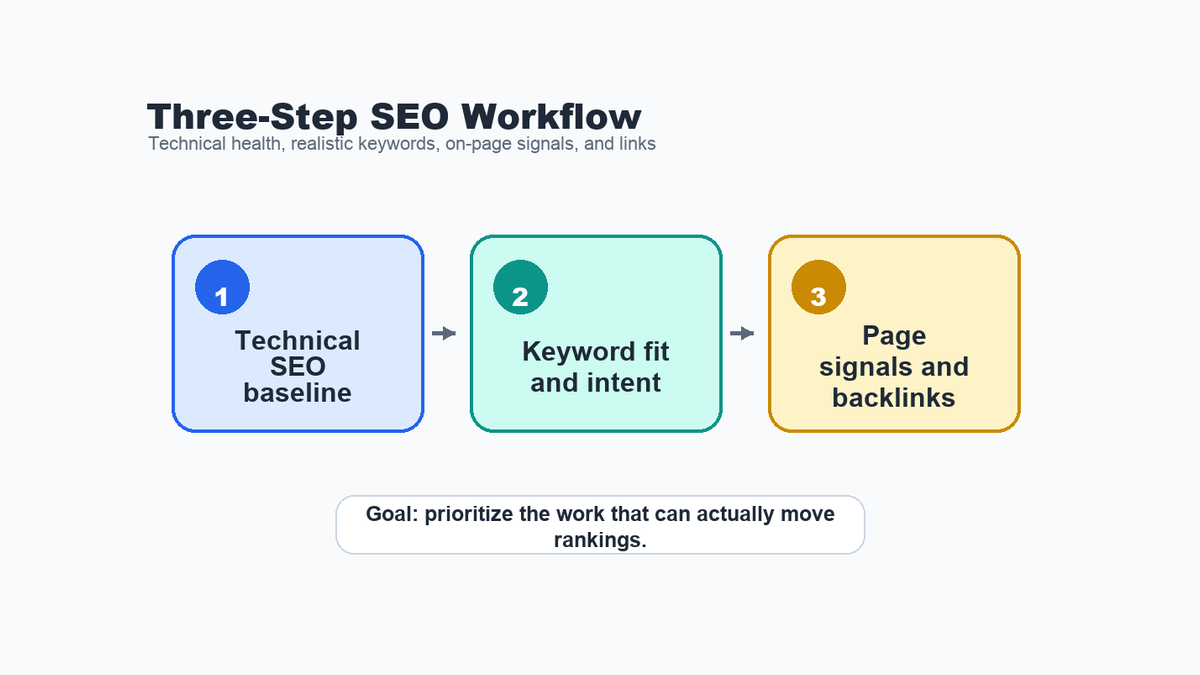
    When I review a site that wants better rankings, I do not start by making a giant list of random SEO tasks. I want a sequence that answers three questions: can search engines read and trust the important pages, are we targeting keywords the site can realistically win, and do the pages have enough on-page relevance and authority signals to compete?

    This post is based on a real Loom walkthrough I recorded for a client, with the written examples generalized so the workflow is useful for other sites too. The same workflow works for a new SaaS site, a service business, or a niche B2B company that needs a practical first SEO plan instead of another raw export.

    Here is the short version: fix the technical baseline, choose realistic keywords, then improve pages and backlink opportunities around those targets.

    Quick result snapshot: A newer or niche site should first remove technical blockers, then validate realistic keyword targets, then improve page signals and backlink opportunities around those targets. The business owner still needs to confirm which keyword themes match the actual offer.

    Start With the Technical SEO Baseline

    Technical SEO baseline checklist for indexability, canonical URLs, meta descriptions, and social tags.

    Before keyword research gets exciting, the site needs the basics in place. If important pages have indexability problems, missing canonical URLs, weak meta descriptions, or incomplete social tags, the strategy can start on shaky ground.

    I usually start with the homepage and the few pages most likely to bring leads. The goal is not to fix every tiny warning immediately. The goal is to find issues that could affect crawling, indexing, search snippets, or how confidently Google understands the preferred page version.

    The first pass usually checks:

    • Whether the page can be indexed.
    • Whether the canonical URL is present and points to the right version.
    • Whether the meta description is long enough and written for clicks.
    • Whether Open Graph and social tags are present enough for clean sharing.
    • Whether the rendered HTML still contains the SEO-critical tags after JavaScript runs.

    This is the same logic behind a good technical cleanup or recovery plan: remove blockers before asking content and links to do all the work. For a deeper example, see WebDesy’s SEO audit recovery plan.

    Choose Keywords You Can Realistically Rank For

    Keyword opportunity matrix comparing search demand, business value, ranking difficulty, and realistic SEO targets.

    The second step is keyword research, but not the kind where you simply grab the biggest-volume phrase and call it a strategy.

    A keyword has to pass a few practical checks. Does it have search demand in the country that matters? Does it match the offer? Does the search result show pages like yours, or is it dominated by huge authority sites? If the site is new or has low authority, the first target may need to be a more specific phrase before the broader head term becomes realistic.

    A simple keyword decision table can look like this:

    Keyword type What to check Best first action
    Core category term Demand, intent, and authority gap Use only if the current SERP is realistically competitive
    Commercial modifier Buyer intent and page fit Build or improve a landing page
    Long-tail problem Specific question and lower competition Create a useful guide or support article
    Competitor term cluster Pages already ranking in the SERP Study the page format and link profile before deciding

    This is why a keyword spreadsheet is not the strategy. The strategy is the decision about which opportunities deserve a landing page, which ones deserve an article, and which ones should wait until the site has more authority. I use the same principle in my keyword research process.

    Map Each Keyword to the Right Page Type

    Search intent map showing commercial, question, and comparison keywords matched to the right SEO page type.

    Once you have a realistic keyword list, the next mistake is trying to use the same content format for every target.

    A commercial keyword usually needs a landing page that explains the service, proof, differentiators, and a clear next step. A question-based keyword may need a blog post or guide. A comparison keyword may need a comparison page. If you mix those intents, you can create a page that feels relevant to no one.

    For a small first roadmap, I like to separate targets into three buckets:

    • Main landing page keywords where the reader may be ready to convert.
    • Blog or guide topics where the reader is researching a problem.
    • Supportive topics that can internally link back to the key commercial pages.

    If the site does not have a blog yet, that is not automatically a problem. It just means the first content plan should be intentional: answer questions that connect to the service, not questions that create traffic with no buyer path.

    Tighten the On-Page Signals

    On-page SEO wireframe showing title, H1, hero copy, subheadings, image alt text, and meta description signals.

    After the target keyword is chosen and mapped to the right page type, the page itself needs to make the topic clear.

    That does not mean stuffing the keyword everywhere. It means using the phrase naturally in the places that help both readers and search engines understand the page: the title, H1 or main hero copy, one or more useful subheadings, image alt text where the image actually supports the topic, and the meta description.

    In the Loom walkthrough, one image alt text was close to the topic but still more brand-focused than keyword-focused. That is a common situation. The fix is not to jam in the keyword mechanically. The fix is to describe the image accurately while aligning the wording with the page’s target topic.

    Before/after example: The goal is not to force the keyword into every field. The goal is to make the page topic clearer while keeping the copy useful.

    Page element Weak version Stronger version
    H1 Platform built for modern teams Privacy risk management software for modern teams
    Meta description Learn more about our platform and features. Use a practical privacy risk management workflow to find issues, prioritize fixes, and connect technical cleanup with search demand.
    Image alt text Dashboard screenshot Privacy risk management dashboard showing issue prioritization and audit status

    A quick on-page check includes:

    • Does the above-the-fold copy make the topic obvious?
    • Does the H1 match the keyword intent?
    • Do subheadings support the query instead of drifting into vague slogans?
    • Do important images have useful alt text?
    • Does the meta description give someone a reason to click?
    Competitor backlink graph showing relevant linking sites, top-ranking pages, and spam sources filtered out.

    The third step is link building, but I like to make it grounded in what already works.

    For a target keyword, look at the top-ranking pages and ask: who links to them, what kind of pages are those links on, and which links are relevant enough to pursue? This gives you a practical outreach list instead of a generic list of websites.

    The important part is quality control. Some competitor backlinks come from spammy pages, scraped directories, or irrelevant sites. Those should be skipped. The useful opportunities are the pages where a relevant resource, expert quote, tool, guide, partner mention, or updated reference could reasonably earn a link.

    The workflow looks like this:

    • Identify the pages ranking in the top results for the target keyword.
    • Review the linking domains and pages behind those results.
    • Remove spammy or irrelevant sources.
    • Look for repeatable patterns: resource pages, industry lists, articles, partner pages, and niche publications.
    • Build outreach around the page you actually want to rank.

    That is the same reason a link building campaign should start with context, not just volume. A related WebDesy example is here: link building campaign kickoff after a core update.

    Use a First-Month Action Plan

    Four-week SEO action plan covering technical baseline, keyword validation, on-page updates, and link targets.

    The easiest way to make SEO vague is to put every possible task into the same priority pile. I prefer a simple first-month plan.

    Download the companion checklist: 3-Step SEO Workflow Checklist (PDF). Use it to turn this workflow into a practical first-month SEO action plan.

    Week 1: Fix the technical baseline on the homepage and key landing pages. Prioritize indexability, canonical tags, metadata, and obvious rendered HTML issues.

    Week 2: Validate keyword targets. Separate landing page keywords from blog topics and flag anything that looks too competitive for the site’s current strength.

    Week 3: Update on-page signals. Improve page titles, main copy, headings, internal links, image alt text, and meta descriptions around the selected targets.

    Week 4: Build the backlink opportunity list. Reverse engineer competitors, remove low-quality sources, and prepare outreach angles for the most relevant pages.

    My first-month SEO checklist:

    • Confirm the business priorities.
    • Audit the key pages for technical blockers.
    • Choose keywords with realistic competition.
    • Match each keyword to the right page type.
    • Update on-page signals without keyword stuffing.
    • Add internal links from relevant existing content.
    • Build a clean competitor backlink opportunity list.
    • Review the roadmap with the business owner before scaling the work.

    Want this turned into a roadmap for your site?

    Send me your homepage, your most important service or product pages, and the keywords you care about. I can turn this same process into a prioritized SEO roadmap with technical fixes, page-type decisions, on-page recommendations, internal-link ideas, and backlink opportunities.

    Get an SEO roadmap

    Common Mistakes to Avoid

    Checklist of common SEO workflow mistakes including ignoring intent, technical blockers, and link quality.

    A good SEO workflow is partly about what you do not do.

    The biggest mistakes I see are:

    • Treating an audit export as the strategy.
    • Choosing keywords only because they have the highest volume.
    • Ignoring whether the current site can realistically compete.
    • Matching a commercial query to an informational blog post, or the reverse.
    • Fixing on-page SEO before checking indexability and canonical signals.
    • Using image alt text as a keyword dumping ground.
    • Copying competitor backlinks without checking quality or relevance.
    • Skipping client review when the keyword list touches product positioning.

    The practical takeaway is simple: each SEO action should be connected to a ranking constraint. If the page cannot be indexed, fix that. If the keyword is unrealistic, change the target. If the page is unclear, improve the on-page signals. If the SERP is competitive, study the links that help competitors win.

    Need help choosing the right SEO priorities? Send me your top pages and current keyword targets, and I can turn them into a prioritized roadmap with technical fixes, page-type decisions, on-page recommendations, internal-link ideas, and backlink opportunities.

    FAQ

    FAQ cards covering what to fix first, realistic keywords, page type fit, and backlink sources in an SEO workflow.

    What is a three-step SEO workflow?

    A three-step SEO workflow is a simple process for prioritizing SEO work: first fix the technical baseline, then choose realistic keywords, then improve on-page signals and backlink opportunities around those targets.

    Should technical SEO come before keyword research?

    For important pages, yes. If a page has crawl, indexability, canonical, or metadata problems, keyword research alone will not solve the underlying issue. You do not need a perfect technical score before strategy, but you should remove obvious blockers early.

    How do I know if a keyword is realistic?

    Check search demand, intent, the authority of the pages already ranking, and whether the SERP contains pages similar to yours. A newer site usually needs more specific targets before it can win broad, competitive terms.

    Do backlinks still matter if the on-page SEO is good?

    Yes, especially when the top-ranking pages have stronger authority or better link profiles. On-page SEO helps the page deserve relevance; good backlinks can help it compete.

    Sources and reference links: Google Search Central on canonical URLs, meta descriptions, and image SEO.


Sitemap